
Published by Cursed Crayon Club
“They Said ‘Okay.’ Why Did They Say It Like THAT?”
The conversation should be over.
They answered your question.
Nothing obviously bad happened.
But twenty minutes later…
You’re back in the messages.
Reading them again.
And again.
Yesterday they said:
“Okay baby ❤️”
Today they said:
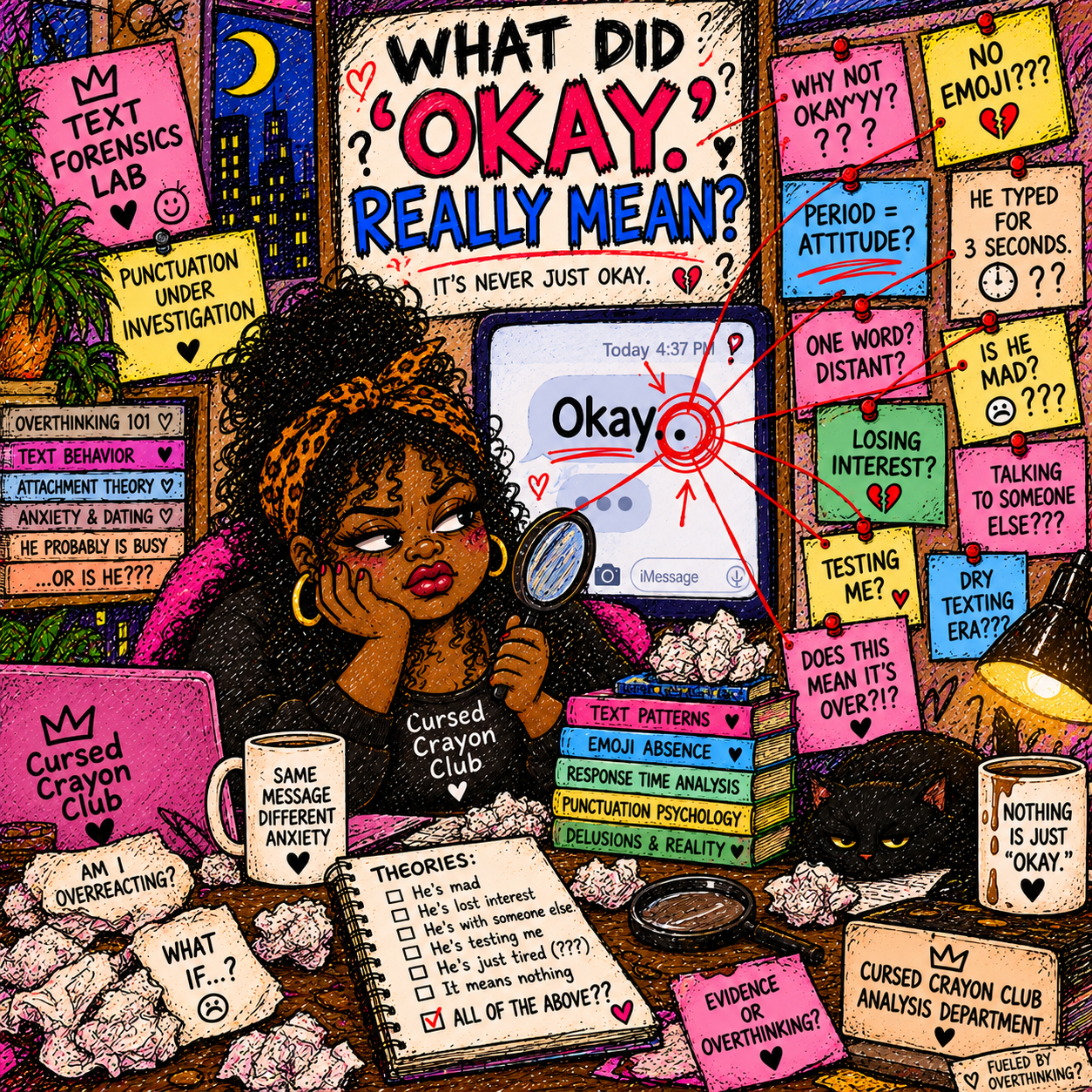
“Okay.”
That’s it.
No heart.
No nickname.
Just…
Okay.
Now your brain has entered detective mode.
“Are they mad?”
“Did I say something wrong?”
“Why did that response feel cold?”
“Are they losing interest?”
“Was that period necessary?”
You scroll backward.
Compare today’s messages with last week’s.
Read the conversation from their perspective.
Maybe screenshot it and send it to your friend:
“Read this. Does this sound weird to you?”
Your friend says:
“It literally just says okay.”
But that’s not enough.
Because you’re no longer reading the text.
You’re trying to figure out what the text means about the relationship.
If you regularly reread messages looking for hidden meanings, psychology offers several reasons why your brain may have such a hard time simply leaving the conversation alone.
Research
Text communication removes many of the cues humans normally use to understand one another.
There’s no facial expression.
No body language.
No immediate tone of voice.
No easy way to know whether someone typed:
“Fine.”
while smiling…
Frustrated…
Distracted…
Exhausted…
Or while standing in the grocery store trying to answer you before their ice cream melts.
That ambiguity leaves room for interpretation.
And sometimes anxiety rushes in to do the interpreting.
1. Text Messages Are Naturally Ambiguous
Face-to-face communication gives us much more information than words alone.
When someone says:
“I’m fine.”
in person, you can hear their tone.
See their expression.
Notice whether they’re relaxed or tense.
A text strips much of that information away.
Now you’re left with:
“I’m fine.”
Your brain has to supply the missing emotional context.
And if you’re already worried about the relationship…
You may supply the worst possible version.
2. Anxiety Makes the Brain Search for Threats
Anxiety doesn’t always look like panic.
Sometimes it looks like analysis.
You reread the message because you’re trying to answer:
“Am I safe here?”
Relationship anxiety can make small changes feel significant.
A shorter response.
A delayed response.
A missing emoji.
A different greeting.
The brain begins scanning communication for signs that something has changed.
3. Attachment Anxiety Can Increase Sensitivity to Rejection
Adult attachment research suggests that people higher in attachment anxiety may be especially alert to cues suggesting rejection, abandonment, or emotional withdrawal.
Ambiguous communication can therefore become difficult to ignore.
Someone else reads:
“Talk later.”
and thinks:
“They’re busy.”
You read:
“Talk later.”
and think:
“Something is wrong.”
The message hasn’t changed.
The interpretation has.
4. Rumination Can Make You Feel Like You’re Solving Something
Psychologists use the term rumination to describe repetitive thinking about distressing concerns.
Rumination can feel productive because your brain keeps telling you:
“One more time.”
“Look at the conversation again.”
“Maybe you missed something.”
But rereading doesn’t always create clarity.
Sometimes it simply creates another interpretation.
Then another.
Then another.
You’re not solving the message anymore.
You’re circling it.
5. Confirmation Bias Can Influence What You Find
Suppose you’re already afraid your partner is losing interest.
You reread the conversation looking for evidence.
Suddenly you notice:
They used fewer emojis.
They didn’t ask what you were doing.
They responded twenty minutes later than usual.
Those details might mean something.
Or they might mean absolutely nothing.
But once the brain develops a theory, it naturally becomes more attentive to information that seems to support it.
That’s one reason rereading can sometimes increase anxiety instead of resolving it.
6. Previous Betrayal Can Make Small Changes Feel Bigger
Sometimes your brain has a reason for being suspicious.
Maybe a previous partner suddenly started texting differently before you discovered infidelity.
Maybe someone repeatedly told you everything was fine while secretly preparing to leave.
Maybe you’ve experienced dishonesty.
Now your brain remembers:
“Last time I ignored the little signs, I got hurt.”
So this time?
You’re watching everything.
That’s understandable.
But a previous relationship’s warning signs aren’t automatically proof that the same story is happening again.
7. Sometimes the Message Actually Is Different
This part matters too.
Not every concern is overthinking.
Communication patterns can genuinely change when someone’s feelings, circumstances, or level of investment changes.
The better question isn’t:
“Did this one text sound weird?”
It’s:
“Is there a consistent change across the relationship?”
Less communication.
Less affection.
Less effort.
Avoiding plans.
Repeatedly dismissing you.
Becoming emotionally unavailable.
A single dry text provides very little information.
A sustained behavioral pattern provides much more.
What the Studies Don’t Tell You
Research can explain ambiguity, rumination, attachment, and cognitive bias.
It can’t explain the emotional violence of receiving:
“K.”
from someone who normally sends paragraphs.
Now you’re staring at one letter like it contains classified information.
“K?”
Not okay.
Not okay baby.
Not even OK.
K.
You read the conversation backward.
Check what you said before it.
Wonder whether your joke offended them.
Check whether they’re online.
Maybe consult your group chat.
Now four people are analyzing one letter.
This is where texting becomes ridiculous…
And incredibly human.
Because sometimes you’re not searching the text for hidden meaning.
You’re searching for reassurance that nothing changed.

✏️ The Cursed Crayon Club Viewpoint
The following is the opinion and interpretation of Cursed Crayon Club, not a statement of scientific fact.
We think sometimes the hidden meaning isn’t hidden.
There isn’t one.
Sometimes:
“I’m tired.”
means they’re tired.
“Talk tomorrow.”
means they’ll talk tomorrow.
“Okay.”
means okay.
But when you’re afraid of losing someone, your brain can turn punctuation into evidence.
Suddenly you’re investigating periods.
Emojis.
Response times.
Capitalization.
Whether they said:
“Goodnight.”
instead of:
“Goodnight baby ❤️ sleep good.”
At some point, you have to ask:
Am I communicating with this person or communicating with my interpretation of them?
But we’re also not going to tell you to ignore your instincts.
If their entire behavior has changed, pay attention.
Just don’t make one text carry the weight of an entire relationship.
Patterns deserve investigation.
A missing heart emoji probably doesn’t.
Final Thoughts
Rereading texts isn’t automatically unhealthy.
Sometimes you’re simply trying to understand a confusing conversation.
The problem begins when rereading becomes your primary method of creating certainty.
Because text messages rarely contain enough information to answer every emotional question.
If you need to reread something ten times to figure out whether someone still loves you…
The answer probably isn’t hiding between the lines.
You may need an actual conversation.
Relationship Reflection
Ask yourself:
- What am I hoping to discover when I reread the message?
- Do I usually find clarity or another reason to worry?
- Am I analyzing their actual words or guessing what they secretly meant?
- Is this one unusual text or part of a consistent behavioral change?
- Am I interpreting this relationship through something that happened to me before?
- Could I simply ask the person what they meant?
And next time you catch yourself reading the same message for the seventh time, ask:
“What new information do I realistically expect to find on read number eight?”
If the answer is nothing…
It may be time to put the phone down.
Stay Connected
📧 Join our email list to get new relationship deep dives and become part of a community that believes every relationship has a story worth understanding.


☕ Love What You’re Reading?
If this article made you laugh at your own texting habits or helped you understand why your mind analyzes every little message consider buying Cursed Crayon Club a coffee.
Your support helps us create more research-backed relationship deep dives, ugly doodles, and relationship psychology content.
Sources & Further Reading
- Hazan, C., & Shaver, P. R. (1987). Romantic Love Conceptualized as an Attachment Process. Journal of Personality and Social Psychology.
- Mikulincer, M., & Shaver, P. R. (2016). Attachment in Adulthood: Structure, Dynamics, and Change.
- Nolen-Hoeksema, S., Wisco, B. E., & Lyubomirsky, S. (2008). Rethinking Rumination. Perspectives on Psychological Science.
- Walther, J. B. (1992). Interpersonal Effects in Computer-Mediated Interaction. Communication Research.
- American Psychological Association — Resources concerning anxiety, rumination, relationships, and cognitive biases.
- National Center for Biotechnology Information — Peer-reviewed research concerning attachment, rumination, digital communication, and interpersonal relationships.
Leave a Reply