
Published by Cursed Crayon Club
“Yesterday We Texted All Day. Today They’ve Barely Said Anything.”
Yesterday, your phone wouldn’t stop buzzing.
Good morning.
“What are you doing?”
Random memes.
Pictures.
Little updates throughout the day.
A goodnight text before bed.
Today?
Nothing.
Well… not nothing.
They texted you.
But it took three hours.
Their answer was shorter.
No heart emoji.
No follow-up question.
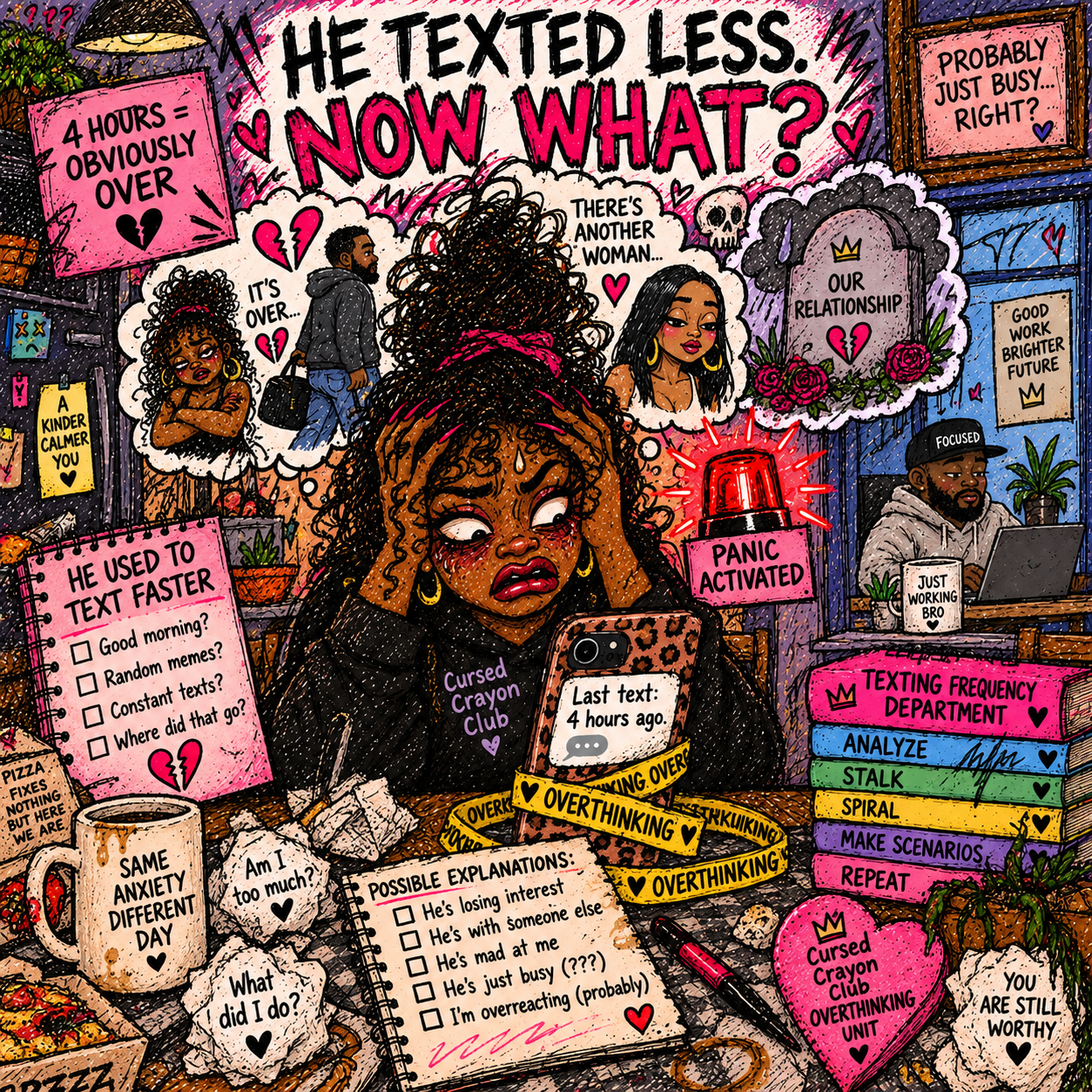
And now your brain has opened an investigation nobody asked for.
“Are they losing interest?”
“Did I say something wrong?”
“Are they talking to someone else?”
“Why are they acting different?”
You reread yesterday’s conversation looking for clues.
Check whether they’re active on social media.
Maybe type a message.
Delete it.
Type another.
Delete that one too.
The rational part of you knows people get busy.
But emotionally?
The change feels like a warning.
If someone’s texting slows down and your anxiety immediately speeds up, there may be more happening psychologically than simply wanting a reply.
Let’s look at what the research says.
Research
Digital communication has become part of how modern relationships maintain connection. Because texting can function as a signal of availability, affection, and responsiveness, changes in communication can carry emotional meaning.
But less texting by itself does not prove that someone is losing interest.
Context matters.
1. Your Brain Notices Changes in Patterns
Humans are exceptionally good at noticing when established patterns change.
If someone has always taken four hours to respond, four hours may not bother you.
But if someone normally responds within ten minutes and suddenly starts taking four hours?
You notice.
The emotional reaction may therefore be less about the actual number of texts and more about the change from what you’ve come to expect.
Your mind starts asking:
“Why is today different?”
2. Texting Can Become a Signal of Relationship Security
Early in dating, texting often provides small, frequent reminders that the connection still exists.
A morning message says:
“I’m thinking about you.”
A random meme says:
“You’re part of my day.”
A goodnight text says:
“We’re still connected.”
When those signals suddenly decrease, someone who relies heavily on them for reassurance may experience the silence as emotional distance.
The phone isn’t just quiet.
To them, the relationship suddenly feels quiet.
3. Attachment Anxiety Can Make Ambiguity Feel Threatening
Adult attachment research suggests that people higher in attachment anxiety can be especially sensitive to perceived changes in a partner’s availability.
A delayed response contains very little information.
And that’s exactly the problem.
Your brain has an empty space to fill.
Maybe they’re working.
Maybe they’re sleeping.
Maybe their battery died.
Or…
Maybe they’re losing interest.
An anxious mind often doesn’t choose the most neutral explanation.
It prepares for the one that could hurt.
4. The Beginning of a Relationship Can Create Expectations That Are Difficult to Maintain
New relationships frequently involve unusually high levels of communication.
People are excited.
They’re learning about one another.
Everything feels new.
There are endless questions to ask.
As the relationship becomes established, texting may naturally become less constant.
That doesn’t necessarily mean affection disappeared.
Sometimes the relationship simply moved from:
“Tell me everything about yourself.”
to:
“I’ll see you after work.”
A decrease in texting intensity isn’t automatically a decrease in emotional investment.
5. Phones Make It Easy to Search for Additional Evidence
Twenty years ago, a delayed response mostly meant waiting.
Now?
You can check whether they viewed your story.
See when they were last active.
Notice they liked someone’s picture.
See that they’re online.
Watch them post while your message still says Delivered.
Suddenly the question isn’t:
“Why haven’t they answered?”
It’s:
“How can they be online and still not answer ME?”
Digital information can create more opportunities to interpret behavior and more opportunities to misinterpret it.
6. Sometimes the Communication Really Has Changed
This part matters.
Not every concern is anxiety.
Sometimes someone genuinely is becoming less interested.
Communication may decrease alongside:
- Less effort to make plans
- Reduced affection
- Less curiosity about your life
- More cancelled dates
- Emotional distance
- Avoidance of conversations about the relationship
That’s different from someone simply texting less during a busy week.
Psychology shouldn’t be used to convince yourself that every uncomfortable change is imaginary.
Look at the whole relationship, not just the notification count.
What the Studies Don’t Tell You
Research can study attachment and digital communication.
It can’t explain why seeing “Active 2 minutes ago” while your message remains unanswered can feel like a personal attack.
It can’t recreate the moment you stare at:
“Okay.”
and wonder…
“Why didn’t they say ‘okay baby’?”
Or when:
“Goodnight ❤️”
becomes:
“Night.”
Now you’re analyzing punctuation like you’re working for the FBI.
That’s where texting becomes emotionally complicated.
Because we’re not only reading words.
We’re interpreting:
Timing.
Tone.
Emojis.
Punctuation.
Frequency.
Energy.
And sometimes we’re trying to extract certainty from a communication method that is naturally ambiguous.

✏️ The Cursed Crayon Club Viewpoint
The following is the opinion and interpretation of Cursed Crayon Club, not a statement of scientific fact.
We think sometimes you’re not addicted to texting.
You’re addicted to what the texting confirms.
“We’re good.”
“They still want me.”
“Nothing changed.”
So when the texts decrease…
Your reassurance decreases with them.
That’s when the phone starts controlling your mood.
Text arrives?
Happy.
No text?
Anxious.
Short reply?
Something’s wrong.
Heart emoji?
We’re back!
That’s exhausting.
Your relationship shouldn’t require a constantly refreshed notification screen to feel real.
But we’re also not going to tell you:
“You’re just overthinking.”
If someone used to communicate consistently and their entire pattern suddenly changes, you’re allowed to notice.
Just don’t write the ending before you’ve had the conversation.
Final Thoughts
Less texting doesn’t automatically mean less love.
Or less attraction.
Or cheating.
Or abandonment.
Sometimes people are busy.
Sometimes communication naturally changes as relationships develop.
Sometimes two people simply have different texting habits.
And yes…
Sometimes reduced communication is part of genuine emotional withdrawal.
The goal isn’t ignoring changes.
It’s learning to distinguish between information and interpretation.
Information:
“They’re texting me less this week.”
Interpretation:
“They’re definitely losing interest.”
Those are not the same statement.
Before your anxiety writes the second one…
Find out what the first one actually means.
Relationship Reflection
Ask yourself:
- Did their communication actually change, or am I expecting constant contact?
- Is texting the primary way I know the relationship is okay?
- Do I feel secure with this person when my phone is quiet?
- Am I looking at one slow day or a larger pattern of emotional withdrawal?
- Have I asked them about the change instead of trying to decode it?
- Does seeing them online without receiving a reply trigger me?
- If they communicated less by text but remained loving and consistent in person, would I still feel unsafe?
And one particularly revealing question:
If your partner couldn’t text you for an entire day, would you still feel confident that the relationship existed?
If that question makes you uncomfortable…
It may be worth exploring why.
Stay Connected
📧 Join our email list to get new relationship deep dives and become part of a community that believes every relationship has a story worth understanding.


☕ Love What You’re Reading?
If this article made you reconsider the relationship between your phone, anxiety, and emotional security, consider buying Cursed Crayon Club a coffee.
Your support helps us create more research-backed relationship deep dives, ugly doodles, and relationship psychology content.
Sources & Further Reading
- Hazan, C., & Shaver, P. R. (1987). Romantic Love Conceptualized as an Attachment Process. Journal of Personality and Social Psychology.
- Mikulincer, M., & Shaver, P. R. (2016). Attachment in Adulthood: Structure, Dynamics, and Change.
- Hall, J. A., & Baym, N. K. (2012). Research examining mobile-phone communication and relational maintenance in close relationships.
- American Psychological Association — Resources related to anxiety, attachment, relationships, and digital behavior.
- National Center for Biotechnology Information — Peer-reviewed literature concerning adult attachment, digital communication, relationship satisfaction, and anxiety.
Leave a Reply